

The mortgage underwriting process is the lender’s review of your finances, credit, loan details, and the property before issuing final approval. The process may take anywhere from one day to several weeks, depending on the complexity of the application and whether additional documents are needed. Possible outcomes include approval, conditional approval, or denial.
Understanding what happens during underwriting, what the underwriter reviews, and how you can prepare may help make the mortgage process easier to navigate.
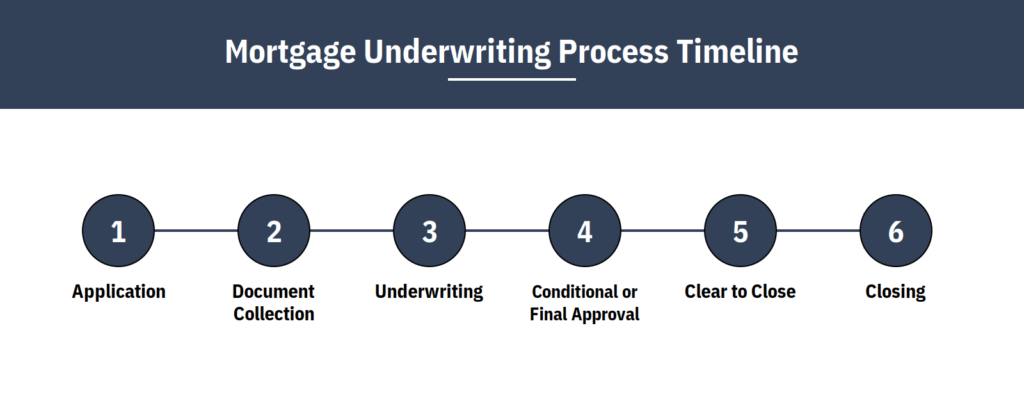
Application → Document collection → Underwriting → Conditional or final approval → Clear to close → Closing
What Is Mortgage Underwriting?
Mortgage underwriting is the process of reviewing a borrower’s loan application, credit history, income, assets, debts, and other financial information to determine whether the application meets the guidelines for a particular loan program.
The underwriter may also review information related to the property, including the appraisal when one is required. The goal is to evaluate the overall loan scenario and determine whether it can be approved.
How Long Does the Underwriting Process Take?
The mortgage underwriting process may take as little as one day or as long as several weeks. The exact timeline depends on the complexity of the application and whether the underwriter needs additional information.
Factors that may affect how long underwriting takes include:
- Whether the application is complete
- How quickly requested documents are provided
- The complexity of the borrower’s income
- Employment and income verification
- Large or unusual bank deposits
- Credit-related questions
- Appraisal issues
- The property type
- The requirements of the loan program
Responding quickly to requests may help prevent unnecessary delays. However, each loan scenario is different, and submitting documents quickly does not guarantee a specific approval or closing timeline.
When Does Underwriting Happen in the Mortgage Process?
Underwriting generally takes place after you submit a mortgage application and provide the requested financial documents.
Your loan originator will help collect the initial information needed for the application. Once that documentation is submitted, the loan may be sent to underwriting for a more detailed review.
Underwriting occurs before final loan approval and closing. The underwriter may request additional documents or explanations before making a decision.
What Does an Underwriter Do?
A mortgage underwriter reviews the financial and property information associated with a loan application.
The underwriter checks whether the information is complete, accurate, and consistent with the guidelines for the requested loan program. The underwriter also evaluates the borrower’s ability to repay the loan and the overall risk associated with the application.
After completing the review, the underwriter may approve the loan, approve it with conditions, or deny it.
What Does a Mortgage Underwriter Look For?
The exact underwriting requirements vary based on the loan program, property, and borrower’s financial profile. However, underwriters commonly review the following areas.
Income and Employment
The underwriter will review your income and employment history to determine whether you have sufficient qualifying income to manage the proposed mortgage payment and your other monthly obligations.
Depending on how you earn income, requested documents may include pay stubs, employment verification, W-2 forms, tax returns, bank statements, or profit-and-loss statements.
Self-employed borrowers may need to provide additional documentation because their qualifying income may be calculated differently from that of a salaried employee.
Assets and Funds to Close
The underwriter will review your assets to determine whether you have enough money available for the down payment, closing costs, and other transaction-related expenses.
Depending on the loan program, the lender may also require you to have additional reserves available after closing.
Large or unusual deposits may need to be explained and supported with additional documentation.
Credit History
The underwriter will review your credit report to understand how you have managed debt in the past.
The review may include your credit score, payment history, account balances, recent credit inquiries, and any history of late or missed payments.
Credit guidelines vary by loan program and may affect the financing options and terms available to you.
Debts and Debt-to-Income Ratio
The underwriter will compare your qualifying monthly income with your recurring debt obligations. This calculation is commonly known as the debt-to-income ratio.
Monthly debts may include credit card payments, auto loans, student loans, personal loans, existing mortgages, and other recurring financial obligations.
The acceptable debt-to-income ratio depends on the loan program and the overall application.
Property Appraisal
A property appraisal may be required to estimate the property’s value and determine whether it supports the requested loan amount.
If the appraised value is lower than expected, the loan amount or other terms of the transaction may need to be reviewed. The underwriter may also request clarification about specific items in the appraisal report.
Down Payment
If you are purchasing a home, the underwriter will review the amount and source of your down payment.
Some loan programs require a specific minimum down payment. The underwriter may compare the down payment with the purchase price, loan amount, and appraised value.
Documentation may also be required to show where the down payment funds came from.
Steps in the Mortgage Underwriting Process
Although every mortgage application is different, the underwriting process generally includes the following steps.
1. Submit the Loan Application and Documents
The process begins when you complete the mortgage application and provide the requested financial information.
Your loan originator may request documents related to your income, assets, debts, credit, employment, and the property being purchased or refinanced.
Review GuardHill’s mortgage documentation checklist for a more complete overview of documents that may be needed for a mortgage pre-approval and loan application.
2. The Loan Is Sent to Underwriting
Once the initial application and supporting documents are collected, the loan may be submitted to underwriting.
The underwriter then reviews the application against the guidelines for the requested loan program.
3. The Borrower’s Financial Profile Is Reviewed
The underwriter reviews your income, employment, assets, credit history, and debts.
Information across multiple documents may be compared to confirm that the application is complete and consistent.
4. The Property Is Reviewed
When an appraisal is required, the underwriter reviews the report to determine whether the property and its value meet the loan program’s requirements.
Other property documentation may also be reviewed depending on the home and transaction type.
5. Additional Information May Be Requested
The underwriter may request updated account statements, employment verification, additional income documents, or letters of explanation.
A request for more information does not necessarily mean there is a problem with the application. It often means the underwriter needs clarification or supporting documentation before making a decision.
6. The Underwriter Issues a Decision
After reviewing the application, financial documents, property information, and loan terms, the underwriter may issue one of three decisions:
- Approved
- Approved with conditions
- Denied
7. Outstanding Conditions Are Reviewed
If the loan receives conditional approval, you will need to submit the requested information before the loan can receive final approval.
Once the documents are provided, the underwriter may conduct another review to determine whether the conditions have been satisfied.
8. Final Approval and Clear to Close
Final underwriting approval means the underwriter has approved the loan based on the information reviewed.
Clear to close generally means the remaining lender and closing requirements have also been completed, and the transaction can move toward closing. These milestones are related, but they may not occur at exactly the same time.
How Long Does Underwriting Take After the Appraisal?
An appraisal is only one part of the underwriting process. Receiving the appraisal does not necessarily mean the underwriting review is complete.
After the appraisal is received, the underwriter may need to confirm that the property’s value supports the requested loan amount and that the report meets the applicable guidelines.
The underwriter may also still be reviewing the borrower’s financial information or waiting for additional documentation. The timeline after the appraisal therefore depends on whether other underwriting items remain outstanding.
What Are the Possible Outcomes of Underwriting?
After reviewing the application, the underwriter will generally issue an approval, conditional approval, or denial.
Approved
An underwriting approval means the application meets the applicable loan guidelines based on the information reviewed.
There may still be administrative, lender, or closing requirements to complete before the loan receives clear-to-close status.
Approved With Conditions
A conditional approval means the loan may be approved once certain outstanding requirements are satisfied.
Conditional approval is a common part of the process and does not necessarily mean there is a problem with the application.
Common underwriting conditions may include:
- Explaining a large bank deposit
- Providing updated bank statements
- Submitting additional income documents
- Completing another verification of employment
- Providing a letter of explanation
- Clarifying an item on the credit report
- Addressing an item in the appraisal report
The outstanding conditions generally need to be cleared before the underwriter can issue final approval.
Denied
If a mortgage application is denied, the loan originator may work with the underwriter to understand the reason for the decision.
Possible reasons may include a debt-to-income ratio that is too high for the requested loan program or a credit profile that does not meet the program’s requirements.
Once the reason is understood, the borrower and loan originator can discuss possible next steps. Depending on the circumstances, those steps may include addressing the issue or determining whether another loan program may be available.
What Happens After Underwriting Approval?
What happens next depends on the type of approval issued.
If the loan receives conditional approval, the borrower will need to submit the requested information and satisfy the remaining conditions.
After those conditions are cleared, the underwriter may issue final approval. Once the lender’s remaining requirements are complete, the loan may be designated as clear to close.
Clear-to-close status means the loan can proceed to the final stages of the closing process.
How Long After Underwriting Does It Take to Close?
Once the loan receives final approval and clear-to-close status, the appropriate parties can coordinate the closing date.
The timing depends on the transaction, the availability of the parties involved, and whether any remaining closing requirements need to be completed.
Depending on the state and transaction, the closing may involve the attorney, settlement agent, title company, real estate professionals, and lender.
Tips for a Smoother Underwriting Process
Understanding what the underwriter reviews can help you prepare and avoid unnecessary delays.
Respond Quickly to Requests
If your loan originator or underwriter asks for clarification or additional documents, respond as quickly as possible.
Review the request carefully and provide all requested pages or supporting information. An incomplete response may result in additional follow-up.
Gather Your Documents Early
Gather your financial documents while completing the loan application so you can provide the requested information efficiently.
Depending on your loan scenario, you may need pay stubs, tax returns, bank statements, employment information, asset statements, identification, or explanations for certain transactions.
Submitting complete and accurate documents may reduce unnecessary back-and-forth during the review.
Avoid Large Purchases and New Credit
The underwriter reviews your financial profile for consistency and stability.
Avoid making large purchases, opening new credit accounts, or applying for new credit during the mortgage process unless you have discussed the situation with your loan originator.
New debt or significant changes to your account balances may affect your credit profile, available funds, or debt-to-income ratio.
Keep Your Finances Consistent
Try to avoid making major financial changes while the application is being reviewed.
Changes in employment, income, assets, debts, or credit may require the lender to evaluate updated information before the loan can move forward.
Contact your loan originator before making a financial decision that could affect your application.
Get Help Navigating Mortgage Underwriting
The mortgage underwriting process helps the lender determine whether the borrower, property, and requested loan meet the guidelines of a specific loan program.
Although the underwriting timeline varies, providing complete documents, responding quickly, and avoiding major financial changes may help the process move forward more efficiently.
GuardHill’s mortgage professionals can help you prepare for underwriting, understand document requests, and navigate the mortgage process based on your specific loan scenario.
Ready to get started? Contact GuardHill Financial to speak with a mortgage professional.
Frequently Asked Questions About Mortgage Underwriting
Why Does a Mortgage Go to an Underwriter?
A mortgage goes to an underwriter so the lender can verify the borrower’s financial information, review the property and loan details, and determine whether the application meets the guidelines for the requested loan program.
What Happens During Mortgage Underwriting?
During mortgage underwriting, the underwriter reviews the borrower’s income, employment, assets, credit history, debts, and funds needed to close. The underwriter may also review the property appraisal and request additional documents or explanations before issuing a decision.
What Are Common Red Flags for Mortgage Underwriters?
Potential concerns may include unexplained large deposits, recent changes in employment or income, new debt, missing documents, inconsistencies in the application, or appraisal issues. A concern does not automatically result in denial, but the underwriter may request more information.
What Should You Not Do During Mortgage Underwriting?
Avoid making large purchases, opening or closing credit accounts, applying for new credit, changing jobs, or moving large amounts of money without first speaking with your loan originator. These actions could affect your credit, assets, income, or debt-to-income ratio.
Does Underwriting Mean You Are Approved?
No. Being in underwriting means your application is being reviewed, not that the loan has received final approval. The underwriter may approve the loan, approve it with conditions, request more information, or deny the application.